

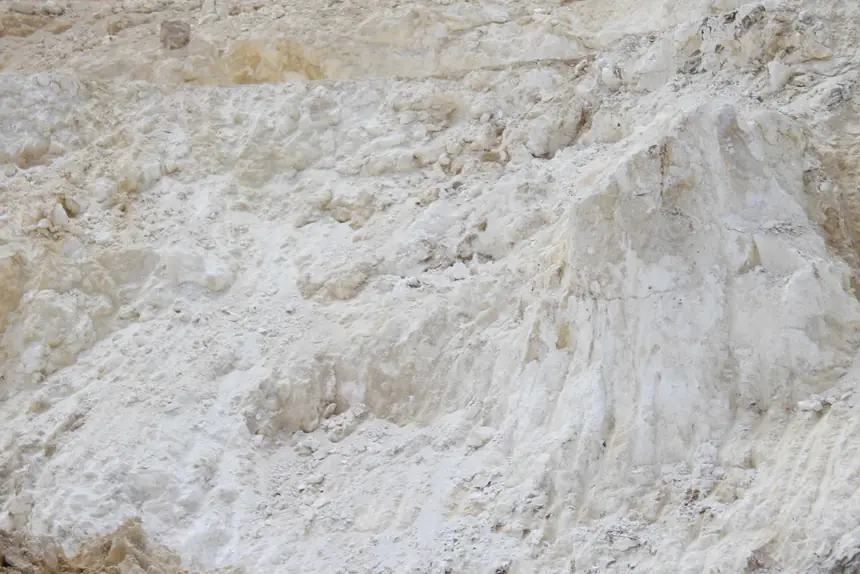
Magnesite is a magnesium carbonate mineral with the chemical formula MgCO₃. Pure magnesite contains about 47.8% magnesium oxide (MgO) by weight, which makes it the most important natural source of magnesium oxide, known in industry as magnesia.
Physical properties
- Crystal system: trigonal (rhombohedral)
- Hardness: 3.5–4.5 on the Mohs scale
- Density: about 3.0 g/cm³
- Colour: usually white or light grey; yellowish and brown tones as iron content rises
Unlike calcite, magnesite does not fizz readily in cold, dilute acid. This is one of the practical ways to tell the two apart in the field.
How does it form?
There are two main types of magnesite. Cryptocrystalline magnesite, very fine-grained and almost amorphous in appearance, forms as veins and networks when magnesium-rich rocks such as serpentinite and peridotite are altered by carbon dioxide-bearing waters. This type is usually very white and pure.
Coarse-crystalline magnesite forms when carbonate rocks such as dolomite and limestone are altered by magnesium-rich fluids. The deposits in and around Eskişehir are of the cryptocrystalline type, hosted in ophiolitic rocks.
Magnesite in Türkiye and Eskişehir
Türkiye is among the countries with major magnesite reserves. Magnesite production in Türkiye began in 1929, and in the 1960s calcined magnesite plants were built in the villages of Sepetçi and Margı (Kozlubel) in Eskişehir. Today Eskişehir is one of the country’s main magnesite centres.
Where is it used?
Most magnesite is fired into magnesium oxide and used as refractory (heat-resistant) material in the steel, cement and glass industries. Animal feed and fertiliser, wastewater treatment, building materials, and the chemical and pharmaceutical industries also use magnesite-based products. We explain the different products obtained at different firing temperatures in our article on sintered and caustic calcined magnesite.