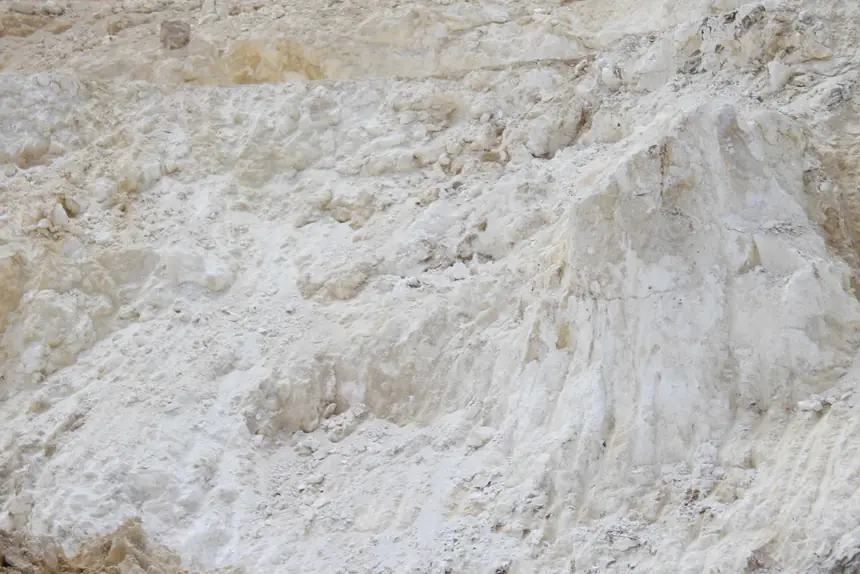

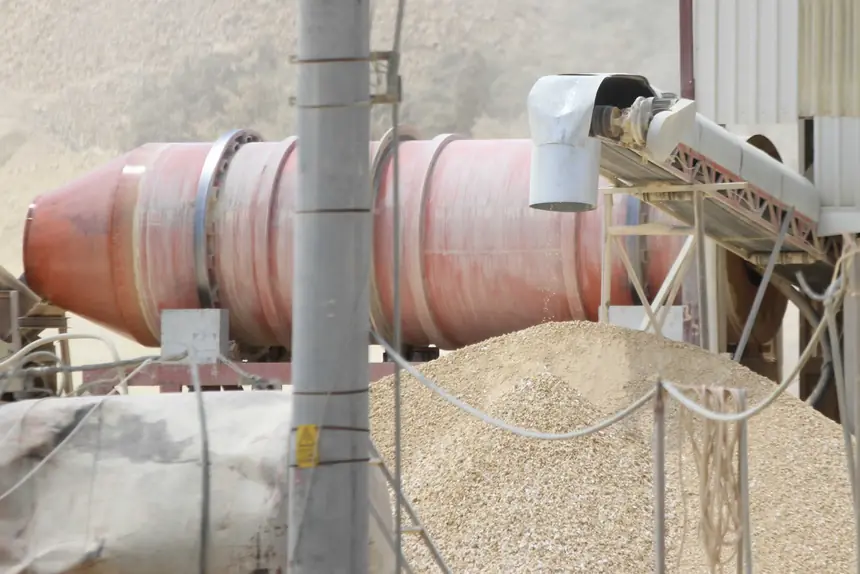
Before use, raw magnesite from the pit usually goes through a heat treatment called calcination. The carbonate breaks down, carbon dioxide is driven off and magnesium oxide remains: MgCO₃ → MgO + CO₂. Firing temperature is the main factor that decides the product’s properties.
Caustic calcined magnesite
This is magnesite fired at about 700–1,000 °C. Its crystals are small, its surface area is large and it is chemically active. That is why it is used in agriculture as a feed additive and fertiliser, in wastewater treatment, in building materials such as magnesia cement, and in the chemical industry.
Sintered (dead-burned) magnesite
This is magnesite fired above 1,400 °C, usually above 1,600 °C. At these temperatures the crystals grow, the material densifies and becomes chemically stable. Because it keeps its shape and strength at high temperature, it is the main raw material for basic refractory bricks and monolithic refractories used in steel ladles, electric arc furnaces and cement rotary kilns.
| Product | Firing temperature | Main uses |
|---|---|---|
| Caustic calcined | ~700–1,000 °C | Agriculture, environment, building materials, chemicals |
| Sintered | Above 1,400 °C | Basic refractory bricks and mixes |
| Fused | ~2,800 °C (electric arc furnace) | High-performance refractories |
Why does raw magnesite quality matter?
After firing, product performance depends on impurities in the raw magnesite such as silica (SiO₂), lime (CaO) and iron oxide (Fe₂O₃). That is why at our Ballık site the ore goes through washing, hand sorting by colour and magnetic separation. Contact our sales team for the chemical analyses of our products.