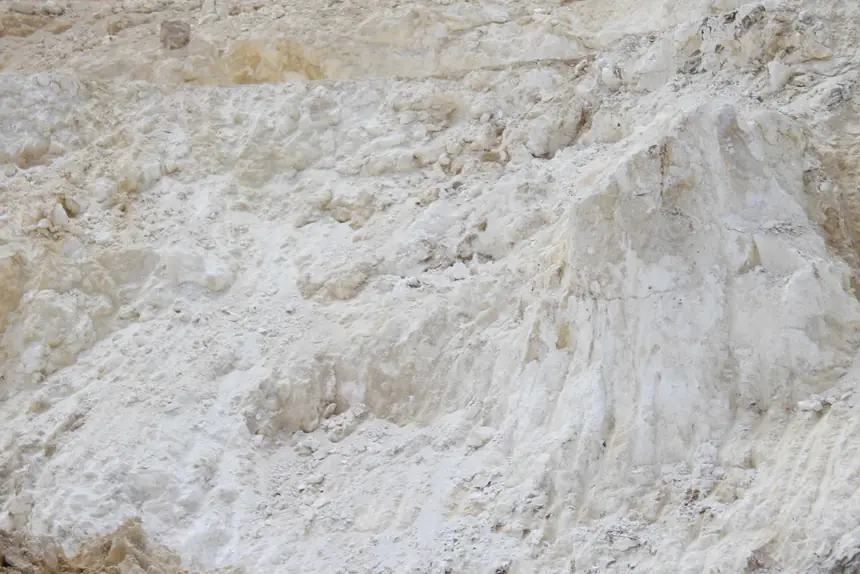

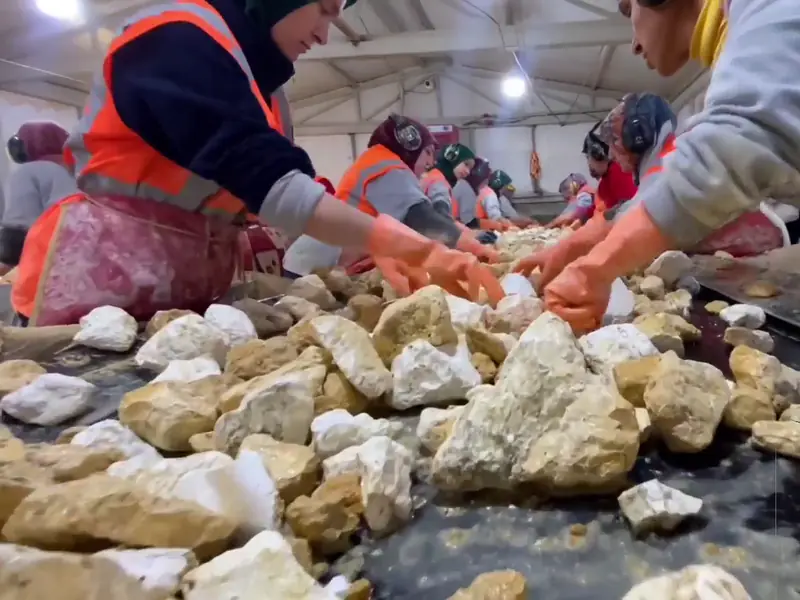
Hand sorting means inspecting the ore by eye on a belt and picking it by hand. It sounds simple, but it is one of the stages that most decides quality in magnesite production, because in magnesite colour is the quickest indicator of purity.
What does colour tell you?
- Snow-white pieces with a porcelain-like look: high-purity magnesite
- Yellowish and brown tones: a sign of rising iron content
- Green and dark pieces: host rock such as serpentinite
- Off-white, glassy and very hard pieces: silica (opal, chalcedony)
White is not always magnesite
The hardest part of sorting is silica, which occurs with magnesite and can look just as white. Silica is much harder than magnesite, is difficult to scratch with a steel knife and has a more glassy lustre. Experienced teams make the call by looking at lustre, the broken surface and texture as well as colour.
Together with washing and magnetic separation
Sorting works best on clean ore. That is why at our Ballık site the ore first passes through a washing drum; once the clay and dust are gone, colour differences are easy to see. The coarse product (2–10 cm) is sorted by hand on the picking belt, while on the fine-grained line (0.5–2 cm) a magnetic separator holds back impurities such as serpentine.
The result: raw magnesite that reaches refractory and calcining plants with fewer impurities and more consistent analyses.